Banff to Jasper on the Icefields Parkway
288 km by Travel Alberta's measure, 232 of them on the Icefields Parkway. The stops in Parks Canada's order, the one fuel stop, the park pass, winter tires from 1 November, and how to make the trip without a car.
Banff to Jasper is 288 km by Travel Alberta’s measure, and Banff & Lake Louise Tourism puts the drive at about 3.5 hours without stops. Parks Canada’s figures make it 287 km: 55 km on the Trans-Canada Highway to Lake Louise, then 232 km on the Icefields Parkway, Highway 93 North, which Banff & Lake Louise Tourism times at about 3 hours. Parks Canada’s own week-long itinerary gives the Parkway a whole day. Three rules shape the trip: you need a park pass even if you never stop, services along the road run only from early May to mid-October, and from 1 November to 31 March winter tires or chains are mandatory.
Without a car
Most of the ways north are seasonal. Brewster Express, Pursuit’s coach line, runs between Calgary, Banff and Jasper in summer; in 2026 its last Calgary to Jasper run is on 17 October and the last run back on 18 October, and its winter timetable from 1 November has no Jasper service. SunDog lists a Jasper, Lake Louise, Banff and Calgary bus, but we have not checked its 2026-27 dates. There is no passenger train: VIA Rail serves Jasper, not Banff, and the Rocky Mountaineer route that linked the two by way of Kamloops, Passage to the Peaks, ran only in June and July 2026 and has ended.
The tour below does both: it drives the Parkway with stops and finishes in Jasper. SunDog Transportation and Tours picks up at hotels in Banff and Lake Louise and stops for about half an hour each at Lake Louise and Peyto Lake. Then come a picnic lunch, three hours at the Athabasca Glacier with the Ice Explorer ride and the Skywalk included, and Athabasca Falls before the drop-off in Jasper. It costs from US$245 as of October 2026, is rated 4.8 from 75 reviews, and can be cancelled free up to 24 hours before; the listing says it is not suitable for people with mobility impairments.
Mind the season: the Icefield activities it includes ran from 1 May to 12 October in 2026, and Pursuit, which runs them, has published 1 May to 11 October for 2027, though tickets may not be on sale yet. On 7 October 2026 the next date showing was 8 October. The same company runs the trip the other way, from Jasper to Banff or Lake Louise, from US$257 and rated 4.8 from 49 reviews.
The stops, in order
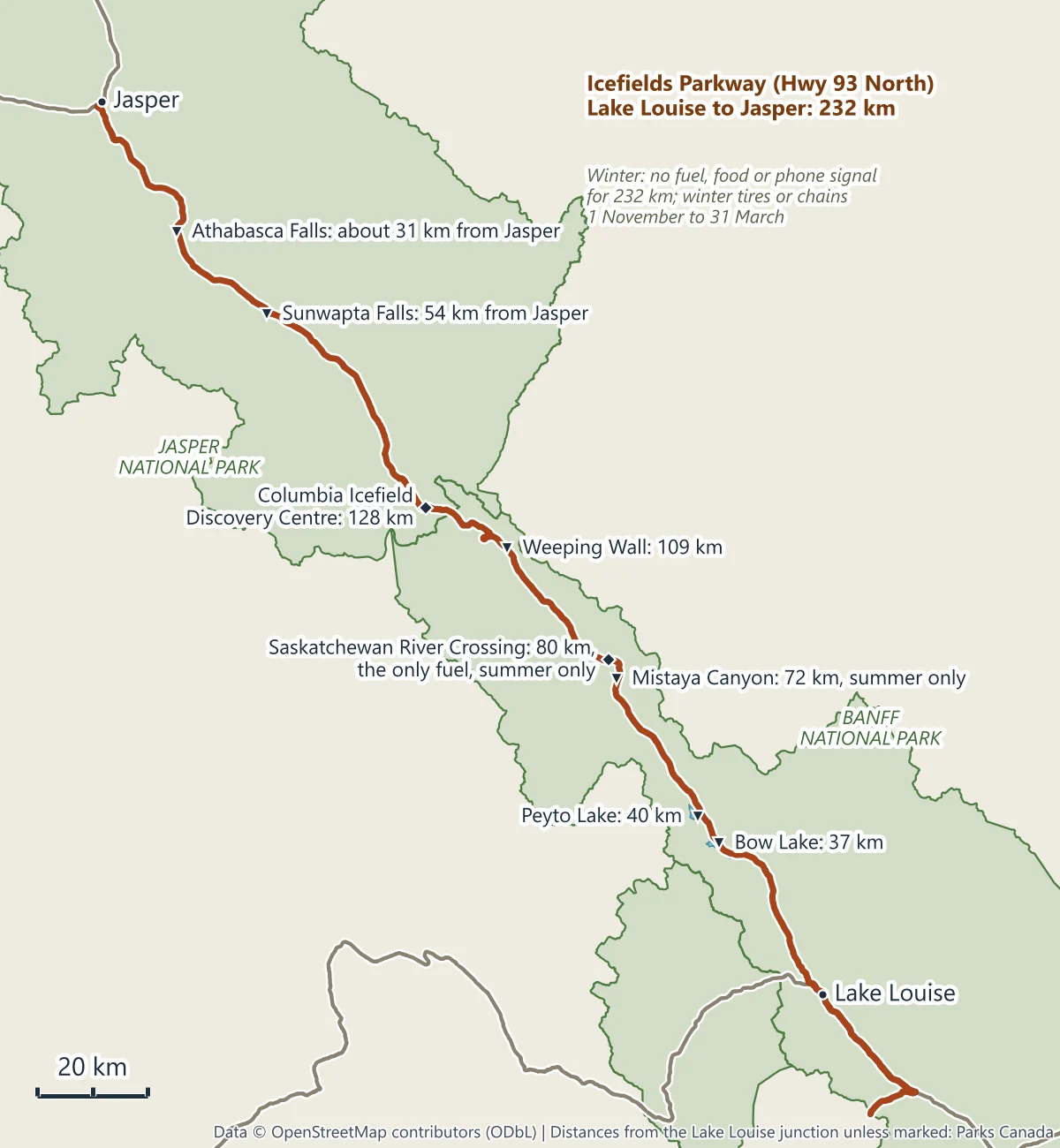
Distances are Parks Canada’s; its own figures for the whole road run from 230 to 233 km, so read them as approximate. Going north from Lake Louise:
| Stop | From Lake Louise | From Jasper | What is there |
|---|---|---|---|
| Bow Lake | 37 km | A viewpoint beside The Lodge at Bow Lake (open May to October); a short gravel trail reaches the shore all year | |
| Peyto Lake viewpoint, Bow Summit | 40-43 km | 190 km | A 0.6 km trail, about 30 minutes return; at 2,070 m, Bow Summit is the highest point on the Parkway |
| Mistaya Canyon | 72 km | A short walk down to a bridge over the canyon, summer only | |
| Saskatchewan River Crossing | 80 km | 153 km | The only fuel on the Parkway, summer only; Highway 11 leaves here |
| Weeping Wall | 109 km | A 300 m cliff where snowmelt streams pour down in spring and early summer | |
| Sunwapta Pass | 2,035 m, the boundary between Banff and Jasper national parks | ||
| Columbia Icefield Discovery Centre | 128 km | 104 km | The Columbia Icefield Adventure and Skywalk; across the road, a free trail to the toe of the Athabasca Glacier |
| Sunwapta Falls | 54 km | Falls in a limestone gorge; a 2.6 km return trail to the lower falls | |
| Athabasca Falls | 203 km | 30 km | Only 23 m high, but “one of the most powerful falls” in the mountain parks, says Parks Canada |
| Jasper | 232 km | The town, at the end of Highway 93 North |
Parks Canada’s walking times are short: about 30 minutes for the Peyto Lake lookout and for Mistaya Canyon, an hour for the 1.8 km return trail to the toe of the glacier. Its smaller pull-offs include Tangle Falls, seen from the roadside, and the Stutfield Glacier viewpoint, “ideal for photos without leaving your vehicle”. Many of the tours listed here also stop at the Crowfoot Glacier viewpoint and the Waterfowl Lakes.
At the Icefield, Pursuit says its Columbia Icefield Adventure takes about 2.5 to 3 hours, with 15 to 25 minutes on the ice, and recommends 40 to 45 minutes for the Skywalk, which you reach only by its shuttle from the Discovery Centre. Do not walk onto the glacier on your own: “Walking on the Athabasca Glacier is not safe,” Parks Canada says, and only guided tours go onto the ice. athabascaglaciertour.com compares the Ice Explorer, the Skywalk and the guided glacier walks in more detail, and the Columbia Icefield page lists the tickets and tours.
Fuel, food and phone signal
Parks Canada’s advice: “Fuel up before leaving Lake Louise or Jasper.” The one gas station, at Saskatchewan River Crossing, opens in summer only. Services run from early May to mid-October, and the lodges keep the same season: The Lodge at Bow Lake (the former Num-Ti-Jah Lodge) from May to October, Glacier View Lodge at the Icefield to 12 October in 2026, and Sunwapta Falls Resort from mid-May to mid-October.
There is no year-round cell coverage either, and from May to early October only limited coverage at the Columbia Icefield. In winter there are no services at all for the whole 232 km.
The park pass
You need a national park pass to drive the Icefields Parkway, even if you never leave the car. Under a Banff superintendent’s order of 8 September 2026, the only roads through the park you may drive without one are the Trans-Canada Highway and Highway 93 South, and only without stopping. In 2026 a day pass costs CA$12.25 for an adult and CA$24.50 for a family or group of up to seven in one vehicle; youth 17 and under enter free, and an adult Discovery Pass costs CA$83.50 for twelve months. A day pass is valid until 4 pm the day after purchase and covers Banff, Jasper, Yoho and Kootenay among others. The Parkway has its own gate, 7 km south of Jasper.
In winter
From 1 November to 31 March, and whenever the road is covered in snow and ice, snow tires (marked with a snowflake or “M+S”) or chains are mandatory. Parks Canada puts winter weather on the Parkway from early November to mid-June, and snow can fall in any month. From October through May the plows work between 7 am and 3:30 pm, the road can close for extreme weather or avalanche control, and its 38 major avalanche paths are marked as no-stopping zones. In March 2026 avalanche conditions closed the Parkway from 18 March; the Jasper end reopened as far as Parker Ridge on 24 March while the section south of it stayed closed. Road conditions are posted on 511 Alberta.
Is the drive from Banff to Jasper scary?
Nothing official calls it scary or difficult. In summer the hazards are ordinary ones: traffic (Pursuit tells coach passengers to expect delays from 1 July to 15 September) and animals near the road. Parks Canada’s rule for wildlife by the road is to slow down, stay in your vehicle and move on. In Jasper in 2026 it is the law within 400 m of any road to keep 100 m from bears, cougars and wolves and 30 m from elk, moose, caribou, sheep and goats, unless you stay inside a legally positioned vehicle. In winter, add the snow, the avalanche paths and 232 km without services or signal.
Is it possible to take a day trip from Banff to Jasper?
To the town, only by driving yourself: at Banff & Lake Louise Tourism’s 3.5 hours each way, that is about seven hours at the wheel before any stops. Day tours from Banff that go north and come back the same day take 8 to 10.5 hours and turn at the Columbia Icefield, at the southern end of Jasper National Park; two listed here go on to Athabasca Falls, 30 km short of the town, before turning back. The tours that reach the town of Jasper are one-way. So when tour copy says “day trip to Jasper”, it usually means the Icefield. The Icefields Parkway page compares the round trips, most of which leave from Banff, Canmore or Calgary.
To end the day in Jasper without a car and still make the stops, the one-way tour above is built for exactly that.
Check the one-way tour's dates
Questions people ask
How long does it take to do the Icefields Parkway?
About 3 hours from Lake Louise to Jasper without stops, by Banff & Lake Louise Tourism’s estimate. We found no Parks Canada driving time, but it plans the drive as a full day in its own itinerary, and SunDog’s one-way trip spends three hours at the glacier alone.
What is the highway between Jasper and Banff?
Two roads in a row. The Trans-Canada Highway (Highway 1) runs the 55 km from Banff to Lake Louise, or there is the slower Bow Valley Parkway (Highway 1A), 48 km of paved road that Parks Canada calls “a quieter alternative”. From Lake Louise, Highway 93 North, the Icefields Parkway, runs to Jasper. Both parkways need a park pass even if you do not stop.
What is the difference between a glacier and an icefield?
An icefield is the large mass of ice on the heights; glaciers are the tongues of ice that flow down from it. Parks Canada describes the Columbia Icefield as more than 300 km² of ice and “the largest icefield in the Canadian Rockies”, feeding several large glaciers, the Athabasca, Columbia and Saskatchewan among them. The Athabasca is the one the Ice Explorers drive onto. From the top of Mount Snow Dome, meltwater flows to three oceans: the Pacific, the Arctic and the Atlantic.
What is the most famous glacier in Canada?
Nobody keeps a ranking. Parks Canada’s own phrase for the Athabasca is “Canada’s most accessible glacier”. It has been receding for 125 years, and from 1985 to 2024, Parks Canada says, the Columbia Icefield lost nearly 13.3% of its ice.
What is the most scenic part of the Icefields Parkway?
No source ranks one stretch above another; Parks Canada says the road “passes through some of the most dramatic landscapes in the Canadian Rockies”. Its highest point is Bow Summit, by the Peyto Lake viewpoint, and its lakes typically thaw by late June, so a May drive looks very different from a July one.
What to avoid in Banff?
Trying to drive to Moraine Lake, whose road is closed to private cars all year; approaching or feeding wildlife (fines up to CA$25,000); flying a drone, banned in all national parks; leaving the trail at Johnston Canyon, banned from 15 May to 15 November to protect black swifts; stopping in the Parkway’s marked avalanche paths; and walking onto the Athabasca Glacier.
What should I not miss in Banff, and what are the big three?
No official body ranks them. The pages on this site follow the places the tours are built around: Banff and its gondola, Lake Louise, Moraine Lake, Johnston Canyon (closed for rock-slope work from 13 October 2026) and Lake Minnewanka. If “the big three” means the ski areas, the park has three: Mt Norquay (tentatively 1 November 2026 to 18 April 2027), Banff Sunshine Village and Lake Louise Ski Resort (both opening 6 November 2026).
How many days should I spend in Banff and Jasper?
Parks Canada’s “Banff and Jasper: the ultimate duo” itinerary takes seven: three around Banff and Lake Louise, one on the Parkway and three in Jasper. The Banff itinerary breaks down the Banff days, and Banff or Jasper covers who each park suits.

Book the One-Way Sightseeing Tour to Jasper
SunDog Transportation and Tours picks you up at your hotel in Banff or Lake Louise, stops along the Icefields Parkway with a picnic lunch, includes the Ice Explorer ride onto the Athabasca Glacier and the Skywalk, and drops you in Jasper. Those Icefield activities ran 1 May to 12 October in 2026. From US$245 as of October 2026, rated 4.8 from 75 reviews, with free cancellation up to 24 hours before.
Check Availability & Book